ToDoList • 2025
Fluid Mobile Design System
ROLE
Product Engineer
TIMELINE
December 2025
Team
Solo
SKILLS
Flutter
iOS Development
UI/UX Design
Overview
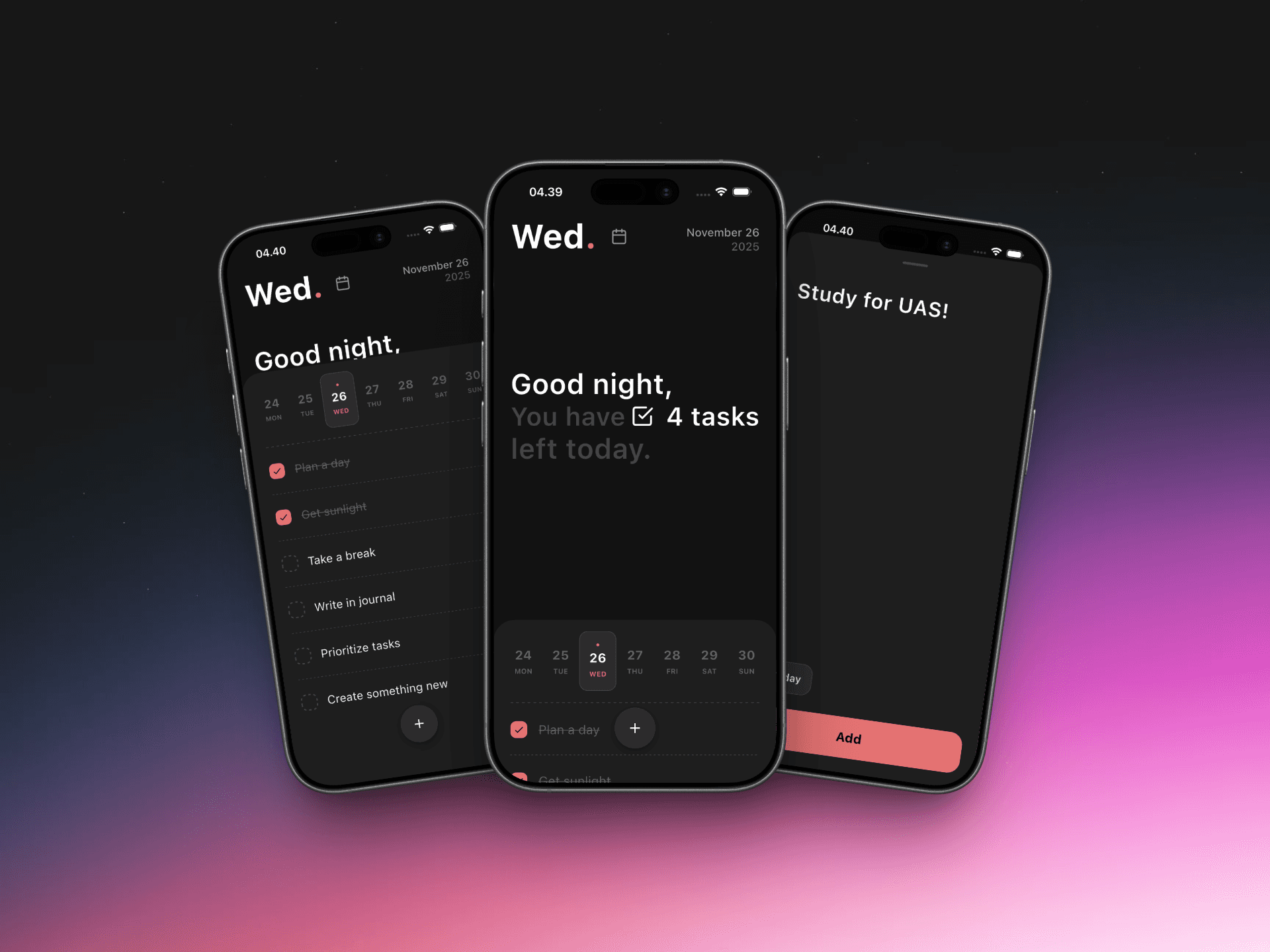
Todolist is a minimalist sanctuary for your daily ambitions, designed to reclaim focus in a distracted world.
Deadlines, daily habits, and academic goals—tasks that often get lost in cluttered interfaces are now given room to breathe. By stripping away the unnecessary, Todolist offers a pixel-perfect environment where fluid animations and robust local performance turn the act of planning into a moment of calm.
Problem
Modern productivity tools often create more friction than flow.
Instead of helping users get things done, most current apps force users to manage the tool itself. Endless menus, complex tagging systems, and cluttered interfaces create a high cognitive load just to capture a simple thought.
When a user opens a to-do app, they need clarity, not chaos. Existing solutions often prioritize data density over visual breathing room, turning the act of planning into a source of anxiety rather than relief.
Approach
Prioritizing mental clarity through the art of subtraction.
I stripped away the non-essential. By removing complex navigational hierarchies and focusing on a single-layer interface, the design reduces cognitive load. The UI acts as a blank canvas, allowing the user's tasks—not the app's features—to take center stage.
Static lists feel like chores; fluid interfaces feel like tools. I implemented physics-based animations to give tasks weight and tactile feedback. Combined with a local-first architecture (offline persistence), every interaction is instant, ensuring the flow of thought is never interrupted by a loading spinner.
Solution
Restoring order to your daily chaos through conscious design.
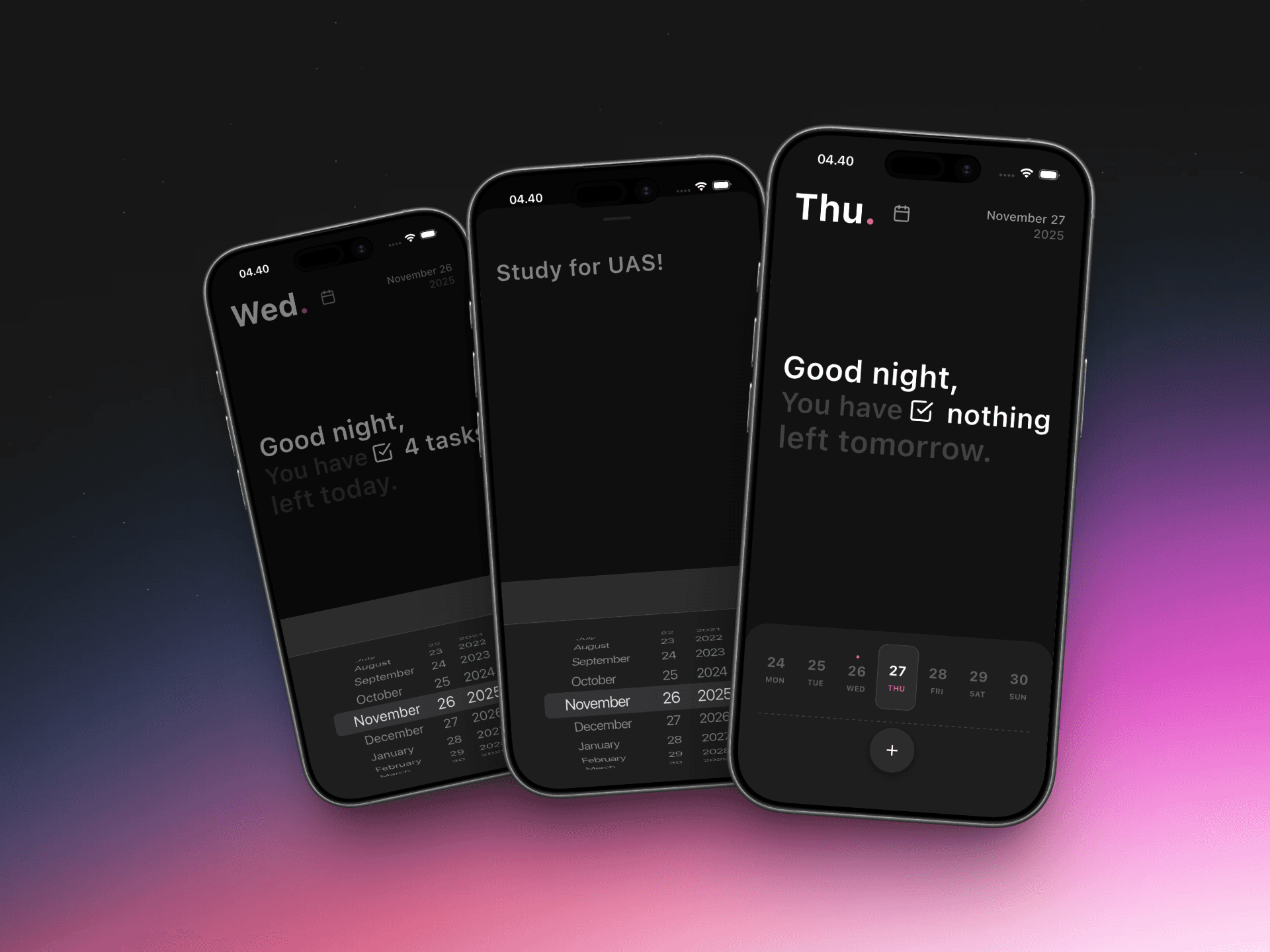
The interface is stripped down to its bare essentials—text and timeline. By utilizing ample whitespace and a focused typographic hierarchy, the app creates a "visual silence" that lets users focus solely on their immediate tasks, not the tool managing them.
Tactile Satisfaction
Completing a task should feel rewarding. I engineered physics-based micro-interactions that give weight to every action. Whether it’s the fluid swipe to delete or the satisfying 'snap' of checking a box, the app turns mundane data entry into a tactile, engaging experience.
Zero-Latency Architecture
Built on a robust offline-first foundation, ToDoList bypasses the latency of cloud synchronization for immediate daily use. The app opens instantly and saves reliably, ensuring that the tool is always ready at the speed of thought—no loading spinners, no waiting.
Technical Architecture
Built for speed, engineered for reliability.
Core Technologies
Framework: Flutter (Dart) — For pixel-perfect cross-platform rendering.
Architecture: MVVM / Clean Architecture — To ensure scalable and testable code.
Local Storage: Hive / SQLite — For instant, offline-first data persistence.
State Management: Provider / BLoC — For predictable app state and smooth data flow.
Achieving smooth animations required rigorous optimization. By minimizing widget rebuilds and offloading heavy data processing to background isolates, the app maintains a consistent 60fps (frames per second) even when handling large lists of tasks, ensuring the UI never freezes.
Reflection
What I learned
Simplicity is an engineering challenge.
Making an interface look simple is often harder than making it complex. I learned that "minimalism" isn't just about removing pixels; it's about predicting user intent so well that UI elements become unnecessary. Every removed button required a more intelligent gesture or automation in the code.
Performance is the invisible interface.
Users may not notice a database query, but they feel a 10ms delay. Building this app taught me that in productivity tools, trust is built on speed. A beautifully designed animation means nothing if the underlying data persistence lags. True aesthetics must be backed by zero-latency architecture.